Environmental Impact
Nyaniso Tutu-Burris
This article is part of a ten-part series exploring the OneThread Ten Pillars of Sustainability — a framework developed to challenge the narrow definitions that have come to dominate sustainability conversations and to explore what sustainability looks like when viewed through an African lens.

~ Market stall in Nairobi
Too often, sustainability is reduced to a handful of environmental metrics, certification labels, or marketing claims. It becomes a conversation about carbon emissions, recycled materials, and eco-friendly packaging while overlooking the broader systems that make true sustainability possible. Yet sustainability has never been just about the environment. It is about people, communities, cultures, economies, governance, innovation, and the interconnected systems that allow both people and ecosystems to thrive.
The OneThread Ten Pillars were developed from the belief that sustainability cannot be understood in isolation. Materials are connected to labour. Labour is connected to communities.
Communities are connected to culture. Culture is connected to economic systems. Environmental impact is woven through all of them.
In the previous article, we explored Ubuntu-Driven Economy and Shared Value, examining how interdependence forms the foundation of sustainable systems and why collective prosperity is often more resilient than extraction. This article turns to a pillar that is often treated as the entirety of sustainability itself: Environmental Impact.
For many people, environmental sustainability is the first thing that comes to mind when they hear the word “sustainability”. Images of melting ice caps, endangered species, rising temperatures, and carbon emissions dominate public conversations. These issues matter deeply. But environmental sustainability has also become one of the most misunderstood and most heavily marketed aspects of sustainability.
In a world increasingly filled with green claims, carbon-neutral promises, regenerative collections, and sustainability campaigns, an important question remains:
How do we distinguish environmental storytelling from environmental impact?
Because sustainability is not measured by what we claim.
It is measured by what we can prove.

Environmental Impact: Who Gets to Define Sustainability?
The Problem With the Polar Bear
When most people think about environmental sustainability, they think about polar bears.
And I think that’s part of the problem.
Not because polar bears don’t matter. Not because climate change isn’t real. And certainly not because environmental degradation isn’t one of the defining challenges of our time. But because if the only reason I should care about sustainability is a polar bear I’ve never met, living on a continent I’ve never visited, while I’m worried about feeding my children tonight, you’ve already lost me.
For many people across Africa, and across much of the Global South, environmental sustainability is often presented as an abstract moral obligation rather than a lived reality. We are told to think about melting ice caps while communities are dealing with polluted rivers, contaminated water systems, rising food costs, droughts, flooding, and the immediate consequences of environmental degradation. The conversation becomes so global that it forgets to be local.
The irony is that environmental sustainability has always been local before it was global. The river matters because someone drinks from it. The soil matters because someone farms it. The air matters because someone breathes it. The environment is not a distant concept; it is the place where life happens.
Yet somewhere along the way, sustainability became a story about the planet rather than the people living on it.
Environmental Impact Is Not Separate From Human Impact
One of the greatest failures of modern sustainability discourse is the assumption that environmental impact exists independently from human impact.
We discuss carbon emissions separately from public health. We discuss waste separately from communities. We discuss water pollution separately from the people who rely on those water systems every day. The result is a fragmented understanding of sustainability where environmental responsibility becomes something that exists “out there” rather than something that affects us directly.
But environmental damage is human damage.
When untreated wastewater enters rivers, it is not simply an environmental issue. It is a health issue, an economic issue, and a community issue. When factories use harmful chemicals that contaminate local ecosystems, the consequences do not stop at the edge of the factory gate.
Those chemicals move through water systems, agricultural systems, food systems, and eventually into human bodies.
This is why environmental sustainability cannot be reduced to a conversation about emissions alone. It must also include water quality, biodiversity, chemical management, waste systems, land use, and the lived experiences of the communities most affected by environmental decisions.
If we claim to care about people, we must also care about the environments they depend on to survive.

~ Woman tending to the environment in traditional clothing
The Greenwashing Economy
The fashion industry has become remarkably good at telling environmental stories.
A biodegradable shoe. A recycled fabric. A compostable package. A carbon-neutral collection. A regenerative capsule collection.
Each year, brands launch new sustainability campaigns designed to communicate environmental responsibility. And while many of these initiatives may have genuine value, they often distract us from a more important question:
What is the actual impact?
A company may produce a shoe made from biodegradable materials, but what happens if that shoe never sells? What happens if thousands of pairs sit in warehouses before eventually ending up in landfills? How much water was used to produce them? How much energy was consumed during manufacturing? How many samples were discarded during development? How much inventory was overproduced?
These are harder questions to answer, but they are the questions that matter.
Environmental sustainability has become very good at measuring what is easy to market and very bad at measuring what is difficult to confront. We celebrate material innovation while ignoring overproduction. We celebrate packaging improvements while ignoring supply chain emissions. We celebrate sustainability campaigns while avoiding conversations about consumption itself.
This is where greenwashing thrives.
Not necessarily through outright deception, but through selective storytelling. Through highlighting the metrics that look good while avoiding the ones that reveal deeper systemic problems.
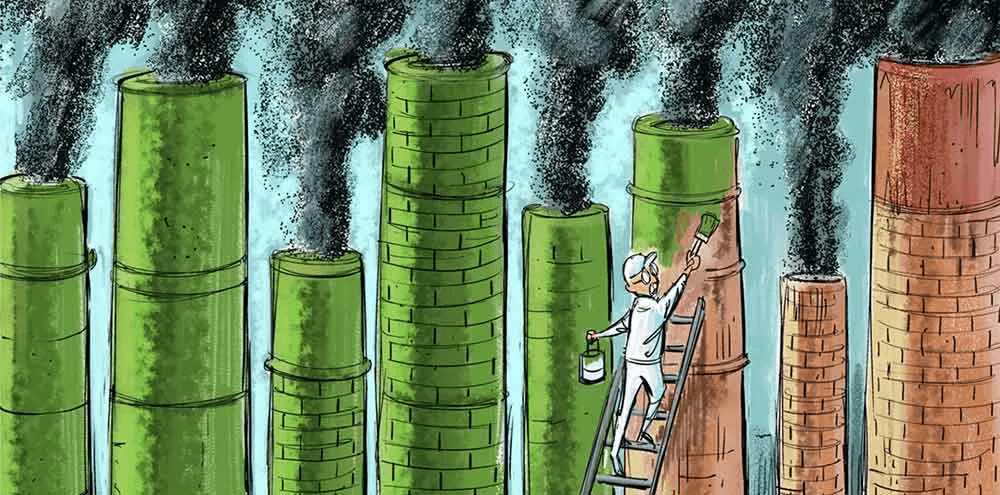
~ Greenwashing, Andy Warhol
The Politics of Measurement
One of the most important lessons I have learned about environmental sustainability came during a conversation with students at the Delight Fashion School in Nairobi, Kenya.
Like many designers, I was discussing fabric preparation. In most fashion education programmes, washing fabric before production is considered standard practice. It removes excess dye, allows shrinkage to occur before cutting, and helps ensure a consistent final product.
To me, it was simply part of the design process.
Then one of the students asked a question that completely changed my perspective.
“Why would we wash our fabric?”
At first, I was confused.
Then they explained.
Water is not an unlimited resource. The same water being discussed as part of a manufacturing process was the same water their families relied on for daily life. There was no extra water available to wash fabric simply because a textbook or manufacturing guide said it should happen.
Suddenly, what I had assumed was a universal sustainability practice revealed itself to be context-dependent.
That conversation taught me something important: sustainability without context is not sustainability at all.
The solutions that work in London may be impossible in Nairobi. The reporting frameworks that make sense in Amsterdam may be meaningless in Accra. The compliance requirements developed in Paris may completely overlook the realities of production in Kampala.
Context does not lower standards.
Context creates accuracy.
And accuracy is the foundation of accountability.
Carbon Credits and the Business of Looking Sustainable
Perhaps nowhere is the tension between sustainability rhetoric and measurable accountability more visible than in the rise of carbon credits.
On paper, the concept appears straightforward. One company reduces emissions. Another company purchases those reductions. The numbers balance. Everyone wins.
But an uncomfortable question remains: Has the behaviour actually changed?
A corporation can continue producing the same emissions while purchasing carbon credits and marketing itself as carbon neutral. Technically, the numbers may balance. But has the organisation fundamentally transformed the way it operates? Has it reduced waste? Has it invested in cleaner systems? Has it changed production methods?
Or has environmental accountability simply become another financial transaction?
The rise of carbon markets highlights a broader challenge within sustainability. Too often, we have become focused on the appearance of environmental responsibility rather than environmental transformation itself.
The goal was never supposed to be looking sustainable.
The goal was supposed to be becoming sustainable.
Those are not always the same thing.
Why Africa’s Environmental Reality Matters
Across Africa, many communities have been practicing forms of environmental stewardship long before sustainability became a corporate framework.
Not because it was fashionable.
Because it was necessary.
Plastic bags are reused. Containers are repurposed. Materials are repaired. Food waste is minimized. Resources are stretched beyond their intended lifespan. Not because people are trying to reduce their carbon footprints, but because waste does not make sense.
This creates an interesting tension in global sustainability conversations.
Africa is often expected to adopt environmental frameworks designed by countries that industrialized through centuries of extraction. At the same time, the continent is expected to create jobs, improve infrastructure, expand manufacturing, and drive economic growth.
The reality is that African sustainability cannot simply be imported.
It must be built through context. Through innovation. Through local realities. Through solutions that recognise environmental responsibility and economic development as interconnected rather than opposing goals.

~ Upcycled bags sold on Facebook marketplace
Meeting Brands Where They Are
One of the challenges with environmental accountability is that many sustainability frameworks assume every business has the same resources, infrastructure, and reporting capabilities.
They don’t.
A multinational corporation with dedicated sustainability teams, auditors, consultants, and compliance officers cannot be measured in exactly the same way as a small fashion brand operating from Nairobi, Cape Town, Lagos, or Accra. The goal should not be to lower standards. The goal should be to create pathways that allow more businesses to participate in sustainability without being excluded from the conversation before they begin.
This is one of the reasons we built OneThread.
Not because Africa needs lower standards, but because Africa needs infrastructure that understands context.
A brand that is not yet measuring water usage still needs a place to start measuring. A business that does not yet have formal environmental policies still needs a way to document what it is already doing. A manufacturer that cannot afford third-party certification today still needs a pathway toward future verification.
At OneThread, we approach environmental sustainability as a journey from intention to evidence.
The first step is visibility.
Can a brand track its waste? Can it record water usage? Can it document its materials, suppliers, production methods, and environmental practices?
The second step is accountability.
Can those actions be supported by records, policies, photographs, receipts, supplier documentation, or environmental logs?
The third step is verification.
Can those claims be independently validated, shared, and eventually aligned with emerging global standards such as Digital Product Passports and other traceability requirements?
Rather than assuming every brand begins at the same point, we help brands build the systems required to move from where they are today toward where they need to be tomorrow.
Because sustainability should not be reserved for the businesses that already have the resources to prove everything.
It should be accessible to the businesses willing to do the work.
The future of environmental accountability will not be built by punishing businesses that are still learning. It will be built by creating systems that help them improve, document, verify, and grow.
That is how sustainability scales.
Not through gatekeeping.
Through infrastructure.
Proof, Not Claims
At OneThread, we believe environmental impact is not a story. It is evidence.
The future of sustainability will not belong to the companies with the best marketing campaigns. It will belong to the companies willing to measure honestly.
Because rivers do not care about press releases.
Atmospheres do not care about ESG reports.
Landfills do not care about sustainability campaigns.
The environment responds to outcomes.
It responds to water usage. To waste systems. To renewable energy adoption. To emissions reductions. To biodiversity protection. To chemical management. To measurable change.
Environmental sustainability is not about saying the right thing. It is about doing the measurable thing.
And that requires accountability.
Not aesthetics.
Not narratives.
Not carefully crafted campaigns.
Accountability.
Because sustainability without accountability is simply branding.
And the environment does not care about your marketing.