Evidence Has Uses: What Is Your Business Information Actually Telling You?
Nyaniso Tutu-Burris

Last week, I asked you to start keeping receipts.
Not literally just receipts... although, please, keep those too.
We looked at the records your business is already producing: invoices, patterns, proofs of payment, photographs, supplier messages, repair requests, agreements, production notes and all the other bits of information that accumulate while you are busy actually running a fashion business.
The exercise was deliberately simple. Find what you already have. Notice what is missing. Start preserving the things that might matter.
So now you have the invoice.
What are you supposed to do with it?
Because keeping evidence for the sake of keeping evidence isn’t particularly useful. The next skill is learning how to read what you have.
Let’s say you bought fabric from a supplier and kept the invoice. Depending on the invoice, it might tell you where you purchased the fabric, when you purchased it, how much you bought and what you paid.
Okay, great. That’s already useful.
Now put that invoice next to the pattern for the garment you made.
If the pattern tells you how much fabric one garment requires, and you know how much fabric you purchased and how many garments you produced, suddenly you can start asking better questions.
How much did the material for each garment actually cost me? How much fabric should I have left? How much became offcuts? Is this garment actually costing what I think it costs to produce?
The invoice hasn’t changed. You just gave it context.
And that is really what we’re learning this week: evidence contains information, but understanding what that information can actually tell you is a skill.

An Invoice Is Not a Magic Piece of Paper
This is where we have to be careful.
Once we start recognising ordinary business records as evidence, it becomes very easy to make them say more than they actually do.
Let’s stay with our fabric invoice.
If I bought fabric from a shop in Johannesburg, my invoice can help demonstrate that I purchased fabric from a supplier in Johannesburg.
Does that mean my fabric was made in South Africa? No.
The shop could have imported it.
Does it mean the fibre originated in South Africa? Also no.
Maybe the invoice includes the fabric name, quantity, price or product code. Great. That gives me more information. If I then have material specifications or information from the supplier, I may be able to follow the story further.
But I can’t make the invoice tell me something it doesn’t know.
The same thing happens with labour.
Imagine you have a proof of payment showing that you paid a seamstress R2,000. What does that tell me?
It tells me that you paid that person R2,000 on that date.
It does not automatically tell me that you pay your workers fairly.
For that, I need more context. What were they being paid for? What rate had you agreed? How much work was involved? What were the working arrangements? Is there an agreement, time record or another piece of evidence that helps us understand what that R2,000 represents?
This is why one piece of evidence can start the story without being the whole story.
It’s also why, within OneThread, we ask for multiple pieces of evidence when we’re trying to substantiate a claim. We’re not collecting documents because we enjoy giving people homework. We’re trying to see enough of the picture to understand what actually happened.
A payment record tells me something. An agreement tells me something else. A photograph or production record might add another piece.
Put them together, and the story becomes much harder to misunderstand.

Sometimes the Useful Information Isn’t What You Were Looking For
Now let’s take something that doesn’t immediately sound like sustainability evidence at all.
A customer sends you a WhatsApp:
Hey, the zipper on my trousers broke.
Annoying. Customer-care problem. You apologise, arrange the repair, fix the trousers and move on.
Except maybe another customer messages you with the same problem. And then another one does.
Now we have something interesting.
Three customers with the same trousers and the same broken zipper isn’t only a customer-service issue anymore. That information could be telling you something about the product itself.
Maybe you need a different zipper. Maybe the way it is being inserted needs to change. Maybe the construction is putting too much pressure on it.
Suddenly, those repair messages have become R&D. They can change the next prototype.
And I love this example because this is where evidence stops feeling like something you’re collecting. After all, an auditor might ask for it one day.
Your own business can use it.
The same thing happens everywhere.
The fabric invoice you kept for accounting can help with costing and supplier history and contribute to traceability.
The pattern you created so that you could reproduce a garment can help you understand material consumption and waste.
Proofs of payment contribute to your financial records, but they can also become part of the record of who your business works with.
A repair log can tell you about customer care, durability and product development. Same evidence. Different questions.

People Will Ask You the Same Question in 100 Different Ways
I have filled in enough grant, funding and business applications at this point to tell you that organisations are incredibly creative about finding new ways to ask you essentially the same questions.
How much traction do you have?
What is your revenue?
What evidence do you have of market demand?
Tell us about your product.
What’s on your roadmap?
How do you know people want this?
After enough applications, you start thinking: I swear I have answered this already. And you probably have.
OneThread doesn’t become a different company every time I fill in an application. Our product hasn’t changed because one form calls something “traction” and another calls it “market validation.”
The underlying information is largely the same. What changes is the question being asked of it.
That’s one of the reasons we keep our own source-of-proof records internally. If somebody asks me about traction, I don’t want to reconstruct OneThread’s history from memory every single time. I want to be able to go back to the evidence and then pull out what is relevant to that particular question.
Fashion businesses are doing the same thing, even if they don’t call it that.
An investor might want to understand how many units you sell, what they cost to produce, what customers pay and whether production can scale.
A corporate buyer considering a large order might care about production capacity and lead times.
A funder might ask how many people your business supports.
A customer might want to know where a material came from.
Someone assessing your sustainability might ask about sourcing, labour, production or waste.
And sometimes nobody outside your business is asking anything. You just need to work out which pair of trousers is actually making you money.
Different questions. Same business. Often, the same underlying records.

Evidence Is Useful When You Can Do Something With It
I want to be careful with the phrase “evidence has value.”
An invoice doesn’t magically become worth money because you filed it correctly.
Keeping beautiful records doesn’t guarantee you funding. It doesn’t guarantee an investor, a corporate contract or a customer.
What it does is make the information your business generates usable. There is a difference between somebody asking:
“How many people did you pay to produce this collection?”
and you saying:
“Um... I think eight? Give me a second. Let me go through my WhatsApps.” versus being able to look at your records and answer them.
Nothing about the actual work changed.
The people you employed didn’t suddenly become more real because you put their records into a folder.
You became better able to demonstrate what happened.
That can matter externally, but it matters internally too.
It means you can compare. You can notice patterns. You can make decisions based on what actually happened instead of what you vaguely remember happening.
And yes, it can also help when somebody challenges you.
If a customer asks where your material came from or questions something you’ve said publicly, knowing your own evidence means you don’t have to respond with another vague sustainability statement.
You can go back to the information.
You can say: this is what we know, this is what we can demonstrate, and this is what we
can’t claim yet.
I actually think that last part is just as powerful as being able to prove something.

This Week, Learn to Read What You Already Have
So we’re not collecting more evidence this week.
Go back to what you found during your Evidence Audit and choose a few pieces. An invoice.
A proof of payment.
A repair message.
A photograph.
A pattern.
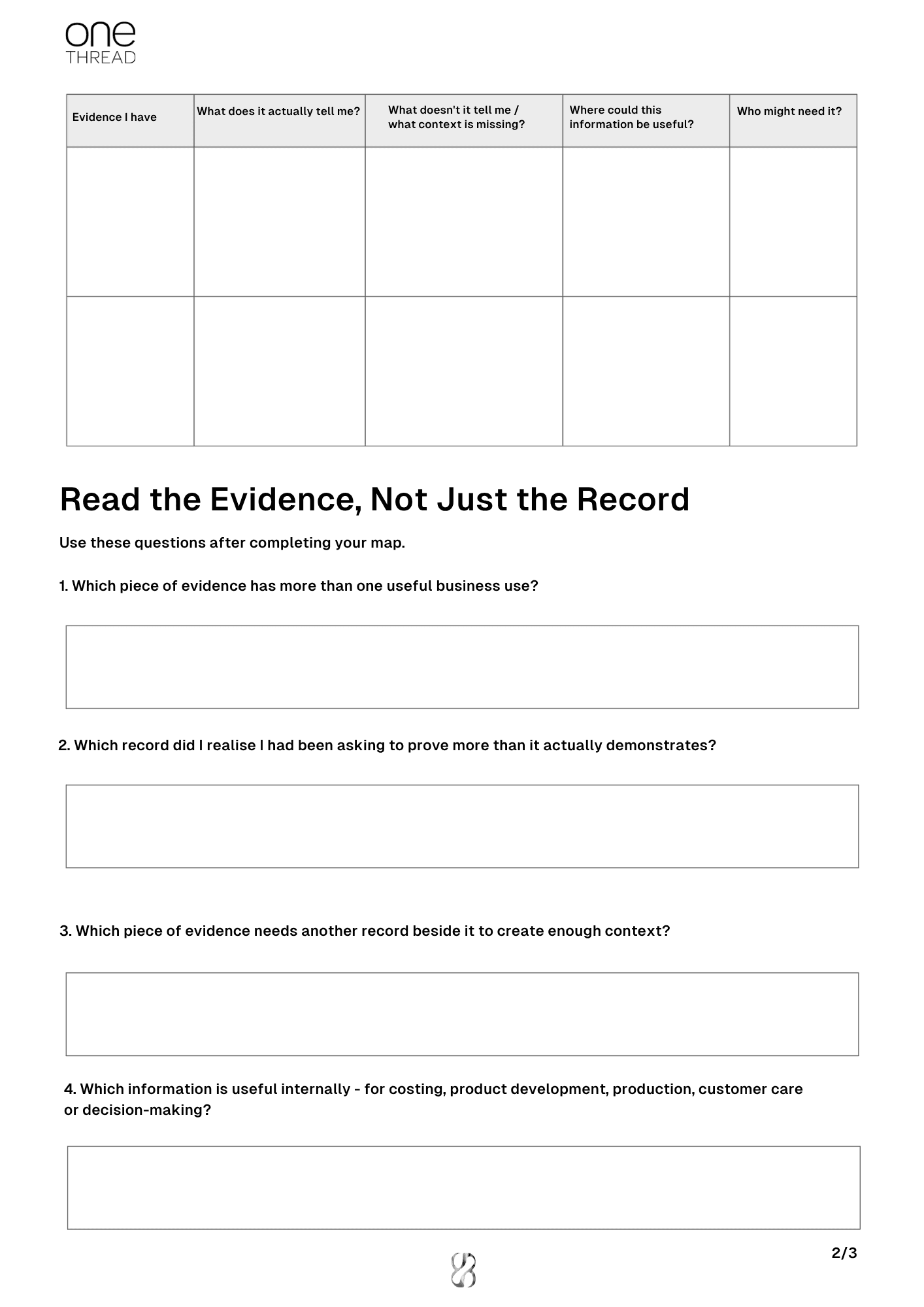
Then interrogate them.
What does this actually tell me?
What doesn’t it tell me?
What else would I need to understand the story properly?
Where could this information be useful inside my business?
Who outside my business might reasonably need it?
That’s what the Evidence-to-Opportunity Map is designed to help you do. And you might surprise yourself.
Something you kept for accounting might also help with sourcing. A customer complaint might contain product-development information. A production record might help you understand waste. Something you collected for a sustainability claim might answer a question in your next funding application.
The goal isn’t to invent more uses for every document you own.
It’s to learn how to recognise useful information when your business produces it. Last week, we learned to find the evidence.
This week, we’re learning how to read it.
Your business is already producing information every day. Before we build another system to collect more of it, we should probably understand what the information we already have is trying to tell us.
Next week, we’ll take the records that have proved genuinely useful and start building something repeatable around them: what gets captured, who captures it, when it gets updated, where it lives and how you find it again.
That’s when evidence starts becoming a system.