Sustainability Isn’t a Claim: What Does “Provable” Actually Mean?
Nyaniso Tutu-Burris

If I ask a sustainable fashion brand what makes them sustainable, I can almost guarantee I’ll hear a story.
“We source locally.”
“We work with artisans.”
“We reuse our offcuts.”
“We’ve been working with the same women for twelve years.”
“We produce in small quantities.”
“We pay our makers fairly.”
And I believe you.
That is actually where I want to start.
Because OneThread is not here to teach African brands how to suddenly become sustainable. Many of you are already doing things that reflect sustainable practice. The problem is that there is a growing difference between doing sustainable work and being able to demonstrate that work to someone who cannot see it for themselves.
This is where we need some new language.
The first thing to understand is that a practice, a claim, evidence and verification are not the same thing.
Think about a designer who buys fabric from a local producer.
The practice is what the business actually does: it buys its material locally.
The claim is what the business says about that practice: “We source our materials locally.”
The evidence is what allows someone else to understand and substantiate that claim: supplier details, invoices, purchase records, material information, sourcing records or other relevant documentation.
And verification is the process of assessing that evidence and determining whether the claim can be trusted according to whatever verification framework is being used.
These four things are connected, but they are not interchangeable.
Practice → Claim → Evidence → Verification
For now, we are stopping at evidence.
Before you can verify something, you have to know what you are trying to prove and what information exists to support it.
Doing the Work Is Not the Same as Showing the Work
The people asking sustainability questions are often not standing inside your workshop.
They weren’t there when you paid the artisan.
They didn’t meet the supplier.
They didn’t watch you save the offcuts instead of throwing them away.
They don’t know that you’ve worked with the same community for twelve years.
You know. Your team knows. Your community knows.
But knowledge that exists inside your ecosystem is different from information that can travel outside it.
Think about social media. We joke that if you didn’t post it, it didn’t happen.
Sustainability is starting to work a little like that.
Not because documentation creates sustainability. It doesn’t.
A spreadsheet cannot make a worker’s conditions fair. An invoice cannot make a material environmentally responsible. A photograph cannot make a supply chain ethical.
Documentation does something different.
It makes the work visible.
And visibility becomes increasingly important when somebody outside your immediate ecosystem needs to understand what your business actually does.

Let’s Take One Claim Apart
Imagine a brand says:
“I’ve worked with the same women for twelve years.”
That is a powerful statement. But what exactly is the sustainability claim?
It could tell us something about community engagement.
It might support a claim about local employment.
It could relate to labour and production ethics.
It could demonstrate skills preservation.
It might even point towards shared economic value or long-term relationships.
Those are not necessarily the same claim.
And because they are different claims, they may require different evidence.
For example, if you are claiming long-term community engagement, you might keep records of the relationship, project history, agreements, communications or community activities.
If you are claiming local employment, you might need information about who is employed, where they are based and the nature of that employment.
If you are making a claim about fair labour, you need a different set of records again: payment records, wage information, working arrangements or other relevant labour documentation.
The point isn’t to create paperwork for the sake of paperwork.
The question is:
What exactly am I saying, and what would allow someone else to understand that it is true?
That is the beginning of provable sustainability.
Where Greenwashing Comes In
This is also where the word greenwashing becomes useful.
Greenwashing isn’t simply “a brand said something sustainable and I don’t like it.”
At its core, greenwashing is about creating a misleading impression of environmental or sustainability performance through claims, presentation or communication that are not adequately supported.
Which means one of the best ways to protect yourself from making weak sustainability claims is to understand the relationship between the claim and the evidence behind it.
If you say, “Our garments are made from recycled materials,” you should know what that means in your business.
What material?
From where?
Recycled from what?
Who supplied it?
What records do you have?
What percentage of the garment does it represent?
What exactly are you claiming?
The stronger your claim becomes, the more important it is to understand what sits underneath it.
This is why documentation does not make you more sustainable.
It makes your sustainability more visible, more communicable and more usable.
That distinction is especially important for businesses whose sustainability practices have historically lived in relationships, memory, oral knowledge and informal systems rather than formal documentation.

Start With What You Already Do
You do not need to begin by creating a giant sustainability department.
Start with your existing business.
Look at the things you already do and ask what they might mean.
A locally sourced material could connect to Materials & Sourcing.
A long-term relationship with makers could connect to Labour & Production Ethics or Community Engagement.
Keeping and reusing production offcuts could connect to Circular Economy & Waste Management.
Recording the story and provenance of a traditional technique could connect to Cultural Sustainability & Narrative Sovereignty.
The important thing is not to force every practice into a sustainability claim.
It is to learn how to recognise the relationship between what happens in your business and what you can responsibly say about it.
That is the skill we are building.
Because once you can identify the claim, you can start identifying the evidence.
And once you know what evidence matters, you can start keeping it intentionally.
That is how documentation begins to become infrastructure rather than administration.
Your First Evidence Exercise
This week, don’t try to document your entire business.
Choose three sustainability claims your business currently makes.
Then take each one apart.
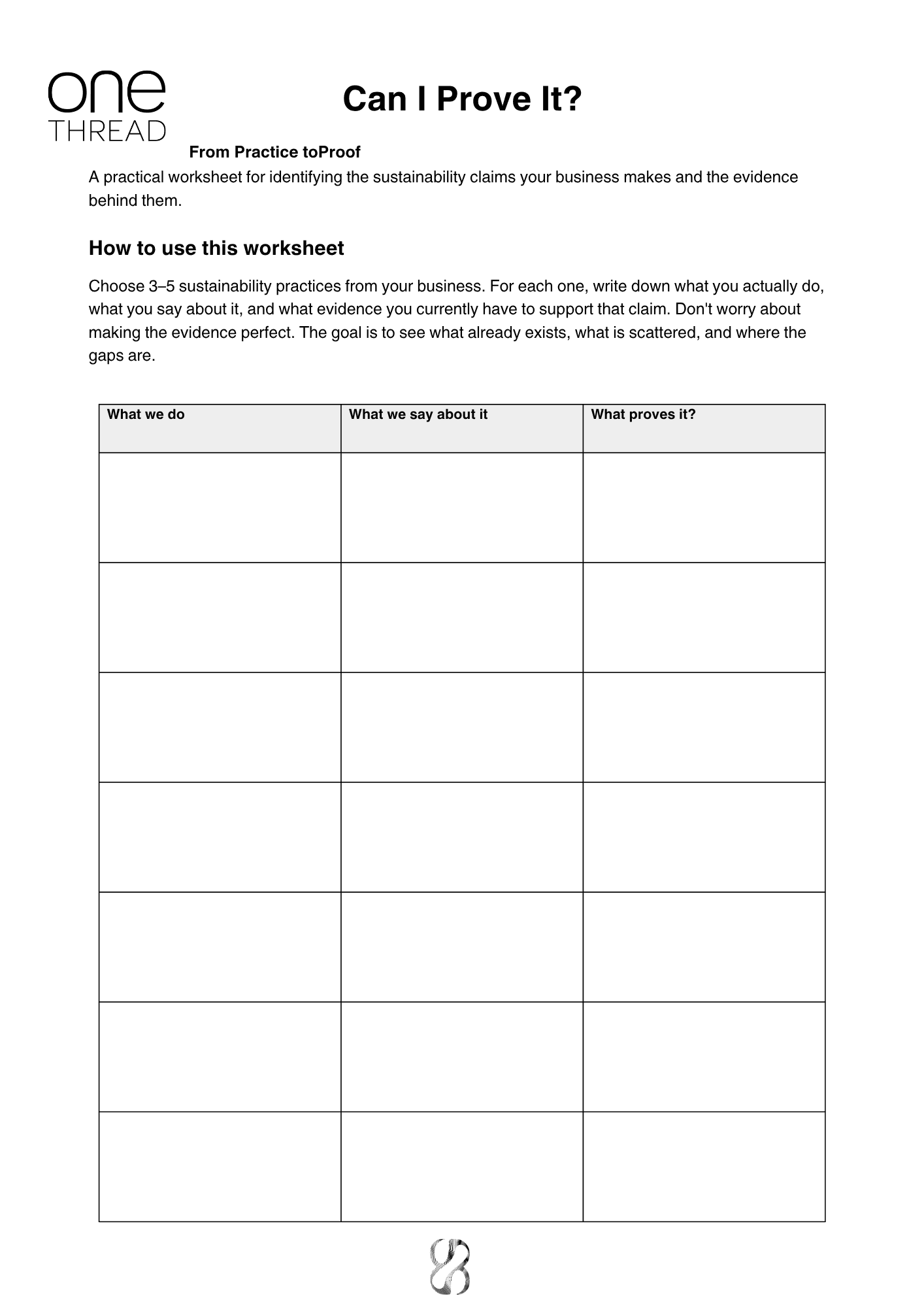
What we do → What we say about it → What proves it
What we do | What we say about it | What proves it |
Buy fabric from local suppliers | “We source our materials locally.” | Supplier details, invoices, sourcing records |
Reuse production offcuts | “We minimise textile waste.” | Waste/reuse log, production records, photographs |
Work with the same artisan group for 12 years | “We support long-term community livelihoods.” | Relationship records, payment records, agreements, project history |
The last column is where the work begins.
You may discover that you already have most of what you need.
You may discover that the evidence exists but is scattered across WhatsApp messages, invoices, notebooks, photographs, bank records and people’s memories.
You may discover that you have a genuine practice but very little documentation around it.
None of those discoveries means your business is suddenly more or less sustainable.
They tell you something about the current state of your sustainability infrastructure.
And that is what we are learning to build.
The Takeaway
A sustainable practice is something your business does.
A sustainability claim is something your business says.
Evidence is what allows someone outside your immediate ecosystem to understand and support that claim.
Verification is the next step: determining whether the evidence sufficiently supports the claim.
They are not the same thing.
Learning to tell the difference is the first step towards building a business whose sustainability can travel beyond the people who already know you.
This week, start with three claims. What do you do? What do you say about it? And what proves it?
If you want to understand where your broader sustainability infrastructure currently stands, you can also take the OneThread Sustainability Quotient.
Next week, we go one step further: once you know what you want to prove, what should you actually keep?